Common Mistakes When Buying Cookware from China (And How to Avoid Them)

Cookware sourcing mistakes from China-1

Introduction

Importing cookware direct from Chinese manufacturers remains one of the most profitable ways for retail brands, restaurant supply wholesalers, and cross-border e-commerce sellers to expand product lines. Stainless steel stock pots, frying pans, non-stick cookware sets, and commercial kitchen pots all carry strong global demand, and China’s industrial hubs deliver unmatched manufacturing scale and product variety.

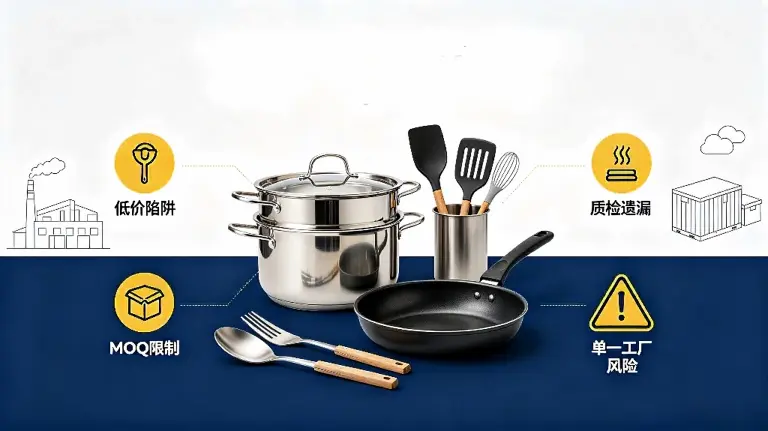
Even with these advantages, hundreds of new importers walk away from sourcing projects with heavy financial losses every year. Most of these costly setbacks stem from predictable, avoidable sourcing mistakes that repeat across every industry buyer group. Many first-time buyers rush into supplier negotiations without clear standards, fixate solely on cheap unit pricing, overlook minimum order rules, skip pre-shipment quality checks, or lock their entire inventory supply to one single factory.

These errors trigger delayed shipments, rusted or defective cookware, customs hold-ups, wasted capital on overstocked inventory, and damaged brand reputation when end customers receive substandard products. As a dedicated kitchenware sourcing agency serving global importers for years, Venus Sourcing has seen every sourcing misstep firsthand. This guide breaks down the four most widespread mistakes buyers make when purchasing cookware from China, paired with practical, field-tested solutions to eliminate risk and protect your profit margins. By the end of this post, you will have a clear playbook to source durable, compliant cookware without unnecessary losses or supply chain headaches.

Choosing Based on Price Only

The number one, most damaging mistake new cookware importers make is selecting suppliers and products entirely based on the lowest possible unit price. It’s understandable for small business owners to prioritize budget control when launching a new cookware line, but rock-bottom pricing always comes with hidden compromises that surface long after your order ships.

Chinese cookware factories build their pricing tiers around raw material grades, production labor standards, safety certifications, and finishing quality. A stainless steel stock pot quoted at 30% less than competing listings will almost always cut critical corners to hit that low price point. The most frequent cost-cutting shortcuts include swapping food-grade 304 stainless steel for cheaper, rust-prone 201 alloy, thinning metal wall thickness to reduce raw metal usage, skipping reinforced riveted handles for weak welded joints, or omitting FDA and LFGB food safety testing entirely.

When cookware uses inferior metal blends, end customers will quickly notice discoloration, rust spots after regular washing, or metal leaching into acidic foods like tomato sauces and vinegar. Thin, cheap cookware warps severely on induction and gas stoves, creating uneven hot spots that burn food, while flimsy welded handles detach after a few months of daily use. Without valid international safety certifications, your entire shipment risks being seized at destination customs, resulting in total inventory loss plus steep customs fines.

How to Avoid This Mistake

  1. Set balanced pricing benchmarks before contacting suppliers: Research market average rates for cookware matching your target material grade, thickness, and certification requirements. Flag any quotation that sits 20% or more below your calculated market average as a high-risk offer.
  2. Mandate full material test reports up front: Require suppliers to share third-party lab certification confirming 304 stainless steel, non-toxic coatings, or food-grade silicone components before discussing order details.
  3. Compare total landed cost, not just unit price: Calculate all associated expenses including sample fees, custom packaging, inspection charges, shipping, and tariffs. A slightly higher unit price with compliant, durable cookware will almost always deliver a far better long-term return than ultra-cheap defective stock.
  4. Request physical pre-production samples: Test low-priced cookware samples for weight, wall thickness, handle stability, and surface finishing to spot shoddy construction before committing to bulk orders.

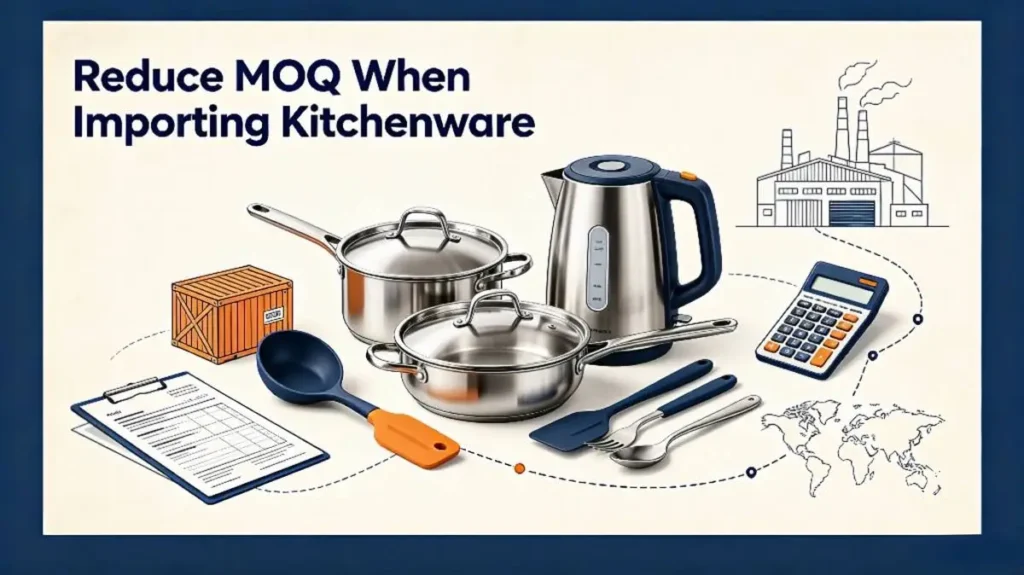
Ignoring MOQ Structure

Nearly every cookware factory in China enforces minimum order quantity rules, yet countless buyers fail to fully understand how MOQ structures impact their total expenditure, inventory risk, and product flexibility. Many importers only ask for a single per-item MOQ number and ignore critical fine print around mixed order allowances, tiered pricing, and custom product MOQ surcharges—this oversight leads to overstocked inventory, inflated order costs, or last-minute production delays when factories reject unqualified small batches.

Two core MOQ pitfalls regularly trip up cookware buyers. First, separating standard stock cookware from fully customized OEM products. Generic in-stock stainless steel pots and pans carry relaxed minimum order limits, while items requiring custom logos, exclusive mold shapes, or unique colored packaging push MOQs up drastically. Buyers who fail to distinguish these two tiers often face sudden demands to double their order volume once they request branding modifications.

Second, most factories split MOQ rules into two separate metrics: per-SKU minimum unit count and total order value minimum. A supplier might require 800 units per single cookware item, but waive that per-item rule if you combine multiple cookware styles to hit a $6,000 total order threshold. Buyers who overlook this mixed-order flexibility force themselves to overbuy one single product, tying up thousands in slow-moving inventory they cannot quickly resell.

Treating MOQ as a rigid, non-negotiable rule is another costly error. Many suppliers offer reduced minimums for trial orders, long-term repeat clients, or consolidated group shipments managed by sourcing partners. Without negotiating these flexible terms, small and mid-sized importers unnecessarily limit their product lineup and increase cash flow pressure.

How to Avoid This Mistake

  1. Clarify dual MOQ rules immediately in all supplier inquiries: Ask separate questions for per-item unit minimums and total order value requirements, plus whether mixed SKU cookware orders qualify for relaxed terms.
  2. Separate standard stock vs custom OEM MOQs: Start market testing with unbranded off-the-shelf cookware to access lower minimums, then scale into private label customization once sales data proves consistent demand.
  3. Negotiate trial order agreements: Frame your small-batch request as a market test with guaranteed future bulk reorders, which encourages factories to slash standard MOQ limits for new clients.
  4. Leverage consolidated sourcing partnerships to split large factory minimums across multiple small importers, drastically cutting your individual order volume requirement.
Cookware sourcing mistakes from China-2

Skipping Quality Inspection

A shocking number of cookware importers place full trust in factory self-reported quality checks and skip independent pre-shipment inspection entirely—this single oversight leads to thousands of dollars in wasted inventory each year. Factory in-house quality control teams prioritize fast production output over strict defect screening, and minor manufacturing flaws hidden in mass production runs only become visible once goods arrive at your overseas warehouse.

Cookware defects that slip past unchecked factory lines cover every critical selling feature: uneven polishing and surface scratches on stainless steel bodies, loose or wobbly pot lids, poorly secured handles that pull away from the pan body, inconsistent non-stick coating application, thin metal walls prone to warping, and misprinted branded packaging. For commercial-grade stock pots like the stainless steel bulk cookware popular with restaurant supply buyers, incomplete rim rolling and sharp unpolished edges create serious safety hazards for kitchen staff.

Worse still, quality issues only surface after full container shipments arrive at your destination. Returning defective cookware to China carries extreme shipping costs, while selling flawed products to retail or commercial clients triggers mass returns, negative online reviews, and permanent brand damage. Many suppliers refuse to accept liability for post-delivery defects if buyers waived pre-shipment inspection clauses in their purchase contracts.

How to Avoid This Mistake

  1. Mandate three-stage quality control for all cookware orders: Raw material inspection before production begins, inline random sampling during mass manufacturing, and full pre-shipment inspection (PSI) once 100% of goods are finished and packed.
  2. Hire neutral third-party inspection teams local to the factory’s industrial cluster. Independent inspectors follow international quality standards with zero bias toward the manufacturer and document all defects with photos and formal reports before shipment.
  3. Add inspection clauses to your proforma invoice: Explicitly state you reserve the right to reject the entire shipment if defect rates exceed an agreed acceptable threshold, with all rework or reproduction costs covered by the supplier.
  4. Conduct personal sample testing ahead of mass production: Physically test cookware samples for heat resistance, handle stability, and surface durability to set clear quality benchmarks the factory must match during full production.
Cookware sourcing mistakes from China-3

Working with Single Factory

Many new cookware importers simplify their supply chain by partnering exclusively with one manufacturing factory, unaware this strategy creates massive long-term flexibility risks that derail growth plans. Relying on a single production facility locks your entire inventory output to that factory’s fixed MOQ rules, limited product lineup, production scheduling timeline, and quality control standards. If the factory faces equipment breakdowns, raw material shortages, labor shortages, or temporary production shutdowns due to local policy changes, you face immediate stockouts and missed seasonal sales windows with no backup supply source.

Specialization limits create another major downside: most Chinese cookware factories only excel at one narrow product category. A stainless steel stock pot manufacturer cannot produce silicone kitchen utensils, ceramic tableware, or electric kettles at competitive pricing or consistent quality. When you only work with one factory, you cannot diversify your product catalog without sourcing from additional vendors and managing separate production timelines, communication threads, and quality checks for each independent factory.

Single-factory partnerships also eliminate your negotiation leverage. Without alternative manufacturing partners to compare pricing and terms, the factory holds full control over unit cost hikes, delayed production lead times, and rigid minimum order policies with no competitive pressure to offer flexible buyer-friendly terms.

Better Solution

Instead of tying your business to one isolated factory, collaborate with a professional sourcing agency that maintains cooperative partnerships with dozens of verified cookware manufacturers across Guangdong and Zhejiang industrial hubs. Sourcing teams consolidate production across multiple specialized factories, delivering four key advantages unavailable to single-factory buyers:

  1. Flexible low minimum order quantities by combining small buyer batches to hit factory bulk production thresholds
  2. Full one-stop cookware product range covering stainless steel pots, frying pans, silicone gadgets, and commercial catering cookware
  3. Backup factory production capacity to avoid stockouts if one facility faces delays or shutdowns
  4. Competitive cross-factory pricing comparisons to lock in fair, stable unit costs year-round

👉 Explore flexible small-batch procurement options tailored for new importers on our Low MOQ Kitchenware Page

Conclusion

Avoiding these four core cookware sourcing mistakes directly saves importers thousands in wasted capital, cuts down on supply chain delays, and protects your brand’s reputation with end buyers. Prioritizing ultra-low pricing without verifying material quality, ignoring complex MOQ fine print, skipping critical pre-shipment quality inspections, and limiting your supply chain to one single factory are all predictable, solvable errors that stem from rushed, under-researched sourcing decisions.

Successful cookware import strategies balance competitive pricing with verified safety standards, flexible order volume rules, rigorous multi-stage quality control, and diversified factory resources to eliminate supply chain bottlenecks. By following the actionable fixes outlined in this guide, you can eliminate avoidable risks, stabilize your inventory pipeline, and build a sustainable, profitable cookware import business without costly setbacks.

The most reliable sourcing workflows combine upfront supplier verification, sample testing, clear written order terms, and multi-factory resource access—all core support services Venus Sourcing provides to every global cookware buyer we partner with.

Need safer sourcing solutions for your cookware import business? Whether you want help vetting compliant cookware manufacturers, negotiating flexible low MOQ terms, arranging independent pre-shipment inspections, or accessing our network of multi-specialty cookware factories, our team of local China sourcing experts delivers end-to-end risk-free procurement support for brands of all sizes. 👉 Contact us today to share your cookware sourcing requirements and receive a customized sourcing plan with transparent pricing and clear quality guarantees.
Welcome to Share this Article
Scroll to Top