Understanding Stainless Steel Materials: 201 vs 304 Grade
Material grade defines nearly every critical attribute of your cookware: overall lifespan, food safety standards, cooking performance, and final wholesale pricing. To avoid defective stock and negative customer reviews, commercial buyers must clearly understand the key differences between the two most common stainless steel grades used in kitchenware manufacturing. Though nearly identical in appearance, their real-world performance differs drastically and shapes your product’s entire market positioning.
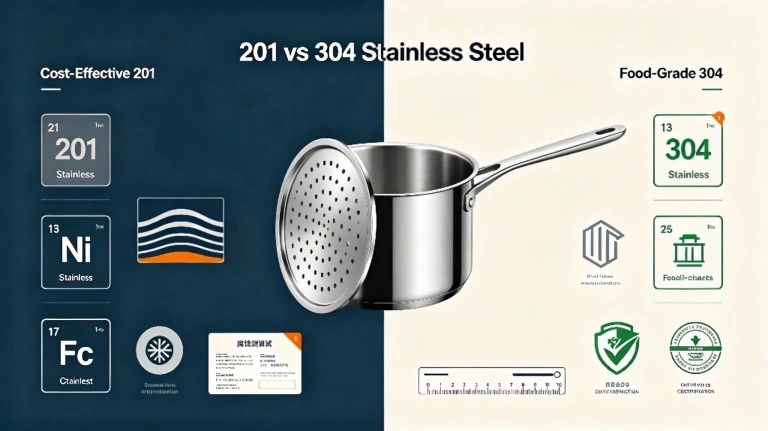
201 Stainless Steel (Cost-Effective Grade)
201 stainless steel is an affordable alloy developed for budget-focused manufacturing. Producers cut costs by reducing nickel content and boosting manganese levels, which weakens its natural corrosion resistance. This grade contains roughly 15% to 18% chromium and just 3.5% to 5.5% nickel, leaving it far less stable in harsh cooking environments. Over time, consistent exposure to acidic ingredients, salty liquids, vinegar, and repeated industrial washing leads to surface discoloration, rust spots, and gradual oxidation.
It fits perfectly for low-cost retail lines, budget hotel kitchens, temporary catering events, and low-usage kitchen tools. If your business targets price-sensitive consumer markets, 201 stainless steel offers unbeatable entry-level pricing. Even so, it’s not suited for premium branding or high-frequency commercial kitchen use, as its shorter lifespan leads to more frequent product replacements and customer complaints down the line.
304 Stainless Steel (Premium Food-Grade Grade)
304 stainless steel is the globally recognized food-safe standard for premium cookware, complying with FDA, LFGB, and other major international food-contact certifications. Its balanced alloy blend, featuring 18% to 20% chromium and 8% to 10.5% nickel with ultra-low carbon content, delivers exceptional resistance to rust, high heat, and chemical oxidation. It holds up for years against acidic, salty, and humid cooking conditions without deforming, degrading, or leaching harmful substances into food.
Easy to clean, completely non-toxic, and structurally stable, 304 stainless steel retains its smooth polished finish even after years of high-heat cooking and routine cleaning. It remains the top choice for high-end retail brands, fine-dining restaurants, professional catering kitchens, and health-focused consumer markets. While its upfront sourcing cost exceeds 201 steel, its outstanding durability drastically reduces after-sales losses and builds stronger brand trust, driving far more sustainable long-term profits.
Thickness and Construction: Core Factors for Cooking Performance
High-quality material alone cannot guarantee reliable cookware performance. Even genuine 304-grade steel cookware will warp, heat unevenly, and wear fast if built too thin or with poor structural design. A cookware’s thickness and layered construction determine its overall sturdiness, heat distribution accuracy, and long-term usability — the top practical factors for both home users and professional chefs.
Cookware thickness is measured in millimeters and directly impacts heat stability and durability. Thin 0.4mm to 0.6mm models are lightweight and low-cost but prone to thermal deformation, creating uneven cooking surfaces and burnt food areas. Mid-range thickness from 0.8mm to 1.2mm strikes a perfect balance of weight, sturdiness, and performance for standard household and light commercial use. Heavy-duty cookware above 1.2mm is built specifically for busy professional kitchens, enduring nonstop heating cycles, frequent deep cleaning, and daily heavy-duty operation without damage.
Multi-layer composite construction is another signature feature of premium stainless steel cookware. Most high-end designs adopt three-layer or five-layer builds, pairing food-safe stainless steel with heat-conductive aluminum core layers. The inner stainless steel layer ensures full food safety, while the middle aluminum layer speeds up and evens out heat distribution across the entire pan or pot base. This structure eliminates the hot spots common on single-layer stainless steel cookware, delivering uniform cooking results and improved energy efficiency.
Smart commercial buyers match construction specs to their target audience. Household retail lines thrive with balanced mid-thickness cookware, while commercial catering orders always require reinforced heavy-duty builds to handle continuous professional kitchen operation.
Handle and Design Details That Determine User Experience
Most new buyers fixate heavily on material grade and thickness while overlooking small design details that shape overall user experience. Handles and structural finishing are key selling points that boost product safety, comfort, and service life, helping your products stand out in crowded retail markets.
Heat-resistant handles are essential for quality cookware. Solid full-metal handles without heat insulation absorb stovetop heat quickly, creating serious burn risks during cooking. Reliable cookware uses hollow stainless steel construction or heat-resistant silicone wrapping to block heat transfer effectively, ensuring safe handling throughout the cooking process for home and commercial users alike.
Ergonomic design also greatly improves user satisfaction. Optimized handle angles, balanced weight distribution, and anti-slip surface treatments reduce hand and wrist fatigue during extended cooking sessions. Large stock pots and heavy frying pans benefit significantly from extended reinforced handles or dual-handle setups, making lifting and pouring safer and more convenient for professional kitchen staff.
Lastly, always confirm riveted handle construction. Pure welded handles tend to loosen or detach after long-term high-heat use and repeated washing cycles. Riveted connections deliver far stronger structural stability, higher weight-bearing capacity, and a longer overall lifespan. Solid rivet reinforcement remains a basic quality benchmark for all mid-range and premium stainless steel cookware models.
Choosing the Right Supplier: Key Sourcing Tips for Businesses
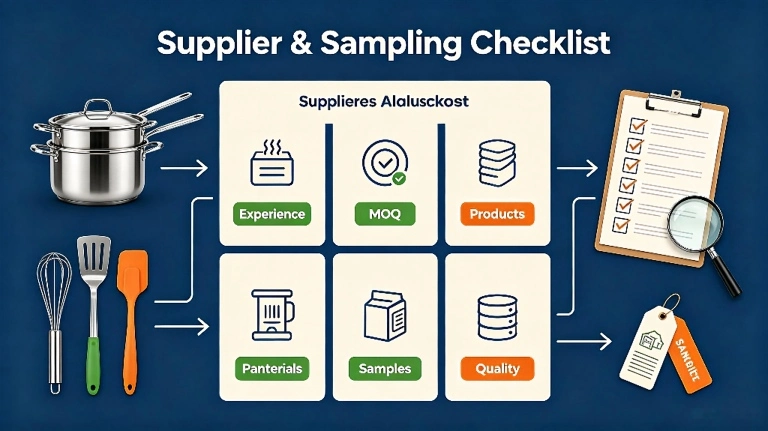
Your supplier choice directly dictates product quality, profit margins, and supply chain stability. For importers, wholesalers, and brand owners, partnering with reliable, flexible manufacturers matters far more than chasing the lowest unit price. Three core criteria should guide your supplier screening process.
First, prioritize MOQ flexibility. Many traditional factories enforce excessively high minimum order quantities, forcing small and medium buyers to overstock inventory and tie up capital unnecessarily. Reputable suppliers offer low-MOQ trial orders for new partners, letting you test market response before scaling bulk purchases and minimizing overall business risk.
Second, seek out suppliers with a complete product range. Manufacturers offering full-category stainless steel cookware, including specialty pans, commercial pots, and bundled sets, support one-stop sourcing. This removes the hassle of coordinating multiple vendors for different items and simplifies logistics, inventory tracking, and after-sales management.
Third, verify available customization options. Generic wholesale products face fierce price competition across global markets, while customized goods create unique brand differentiation. Professional suppliers deliver tailored solutions to fit your exact market positioning.
Relying solely on a single factory often limits your order flexibility, product variety, and customization potential. Working with a professional sourcing team offers a more practical alternative. It consolidates verified factory resources from major production hubs, matching you with the most suitable manufacturer based on your order size, product specs, and customization needs for fully flexible, streamlined procurement.
 View cookware sourcing options: Cookware supplier solutions
Custom Cookware (OEM & Private Label) for Brand Building
If you want to build a sustainable, independent cookware brand instead of competing in saturated generic wholesale markets, OEM and private label customization is your most effective growth strategy. Customized stainless steel cookware helps you stand apart from identical mass-market products, build strong brand recognition, and unlock higher profit margins.
Logo Customization delivers simple yet impactful branding. You can add your exclusive brand logo, trademark, or slogan through laser engraving or screen printing on pan bodies, lids, or handles. Clean, consistent logo placement boosts brand exposure and makes your products appear more professional and trustworthy to retail shoppers.
Packaging Design instantly elevates product grade and market appeal. Basic neutral packaging only serves basic wholesale needs, while custom gift boxes, colored retail packaging, and branded outer cartons enhance product texture, support higher retail pricing, and adapt perfectly for gift sales and promotional bundles.
Private Label Customization enables full independent brand operation. You can customize product thickness, surface finishes, handle styles, and functional details based on your market research and target customer preferences. Fully customized private label products avoid homogeneous price competition and create valuable premium branding space for your business.
Start here: OEM kitchenware solutions
Conclusion
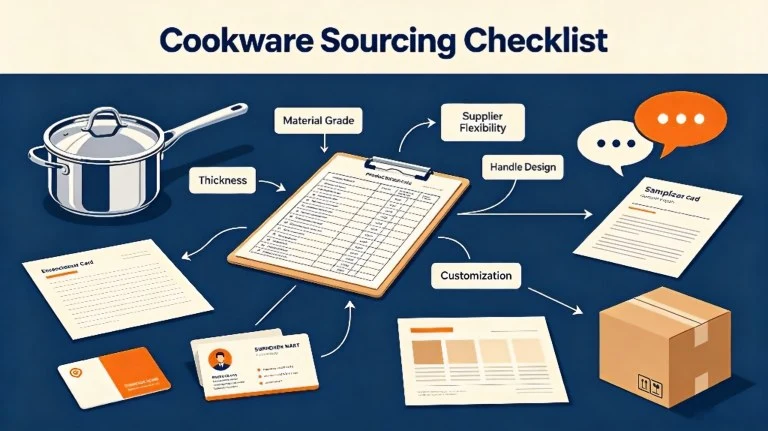
Sourcing the right stainless steel cookware for your business requires careful evaluation of material quality, product type, structural build, user-focused design, and supplier reliability. There is no one-size-fits-all “best” cookware — only the optimal option for your unique market and brand positioning.
Budget-oriented market segments work well with durable, cost-effective 201 stainless steel cookware, while commercial kitchens and premium retail lines should always use food-grade 304 stainless steel for maximum safety and long-term durability. Balance your inventory with versatile frying pans, practical stock pots, precise sauce pans, and high-value cookware sets to cover diverse customer demands. Always inspect thickness consistency, heat conduction performance, and handle construction quality before bulk ordering. Pair quality products with flexible supplier partnerships and strategic OEM customization to build unique brand advantages and sustain steady, long-term business growth.
Need help choosing the right cookware?
Contact us for product recommendations and quotations.