How to Choose the Right Cookware Supplier for Your Business
Introduction
For importers, retail brand owners, and wholesale distributors building a sustainable kitchenware business, choosing the right cookware supplier is the single most critical decision. Your supplier directly controls product quality, pricing stability, shipment timelines, customization support, and overall supply chain risk. Many new sourcing businesses fail not because of poor market demand, but because they partner with mismatched, unreliable manufacturers that cause delayed orders, inconsistent finishing, hidden fees, and repeated after-sales issues.
China remains the world’s leading cookware manufacturing base, offering unmatched product diversity, mature production technology, and cost advantages. However, the huge number of factories and trading companies makes supplier screening extremely challenging. Some factories excel at high-end stainless steel cookware but enforce strict high MOQs, while others support flexible small-batch orders but lack standardized quality control systems. Without a clear evaluation framework, buyers often choose suppliers based solely on low prices, which leads to long-term operational losses.
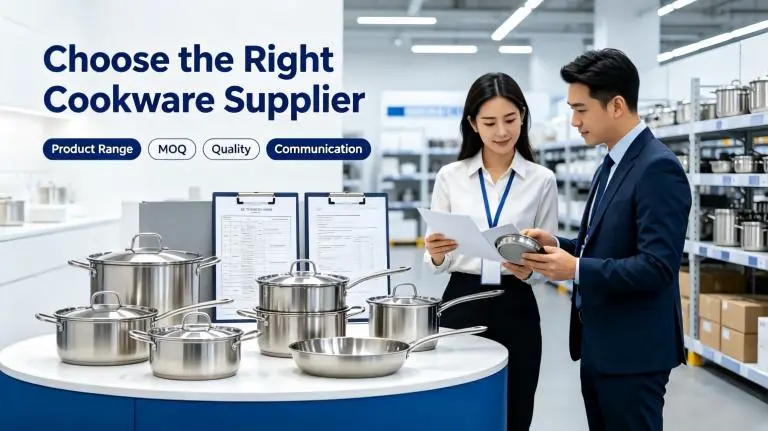
This practical business-focused guide breaks down exactly how to choose the right cookware supplier for your unique business needs. We will cover four core evaluation dimensions: product range diversity, MOQ flexibility, professional communication standards, and multi-supplier comparison strategies. By following this structured method, you can eliminate high-risk partners, stabilize your product quality, and build a scalable long-term cookware sourcing system.
Check Product Range: More Variety Equals More Business Flexibility
The first key factor to evaluate when selecting a cookware supplier is product range completeness. Many new buyers overlook this point and only focus on whether the supplier can produce their current target products. While short-term order completion is important, a limited product lineup will restrict your brand’s long-term growth and product iteration capabilities.
Reliable professional cookware suppliers maintain a comprehensive and categorized product system, covering mainstream consumer and commercial kitchenware categories. A qualified supplier portfolio usually includes stainless steel cookware sets, non-stick frying pans, cast iron cookware, daily-use sauce pans, stock pots, and supporting kitchen accessories. This complete product coverage allows you to expand your product line at any time without switching manufacturers or rebuilding supplier cooperation systems.
Working with a full-range supplier also simplifies your logistics and inventory management. Instead of sourcing cookware from one factory, kettles from another, and utensils from a third vendor, you can consolidate multiple SKUs into one mixed container shipment. Mixed order loading effectively reduces your average shipping cost per unit, shortens overall lead times, and unifies product packaging styles for consistent brand presentation.
In contrast, suppliers with extremely single product categories force you to disperse your orders across multiple manufacturers. This leads to fragmented supply chains, inconsistent quality standards, repeated communication costs, and higher overall operational risks. For growing kitchenware brands, diverse product capability from your core supplier is essential for long-term business flexibility and market expansion.

Evaluate MOQ: Flexible Low MOQ Reduces Startup and Inventory Risk
Minimum Order Quantity (MOQ) is one of the biggest thresholds that determine whether a supplier matches your business stage. Many traditional large-scale cookware factories set rigid high MOQs to ensure mass production profits, which creates huge inventory pressure for small and medium-sized importers, startup brands, and market-testing projects.
When evaluating suppliers, you need to distinguish between standard product MOQs and customized product MOQs. Trustworthy suppliers offer tiered MOQ policies for different order types. Blank, unbranded standard cookware usually features low minimum order quantities, allowing new buyers to conduct small-batch trial orders to test local market acceptance. For simple customizations such as laser logo printing or basic packaging adjustments, flexible kitchenware suppliers will appropriately lower their thresholds for new cooperative clients to build long-term partnerships.
A supplier’s MOQ flexibility directly reflects its market positioning and customer service awareness. Factories that only accept bulk orders are usually oriented toward large wholesale dealers and lack patience and supporting policies for emerging brands. In comparison, modern customer-oriented cookware manufacturers understand market iteration rules and support small trial orders, mixed SKU consolidation, and gradual order scaling according to buyer sales performance.
Choosing a supplier with reasonable MOQ flexibility greatly reduces your business risks. You can avoid overstocking slow-moving products, adjust your product portfolio flexibly based on market feedback, and steadily expand your order volume after verifying stable sales demand. This low-risk growth model is especially suitable for cross-border e-commerce sellers and new kitchenware brand founders.
Assess Communication: Clear and Professional Communication Ensures Smooth Sourcing
Cross-border kitchenware sourcing involves multiple complex links including product confirmation, sample development, production scheduling, quality inspection, and logistics arrangement. Many invisible sourcing risks actually stem from poor supplier communication. Unclear replies, delayed responses, ambiguous terms, and passive after-sales communication will lead to production errors, delayed shipments, and unnecessary economic losses.
Reliable cookware suppliers always maintain standardized and efficient communication habits. First, they provide timely and consistent responses. Regardless of time zone differences, professional sales teams reply to buyer inquiries within one working day and actively follow up on order progress instead of waiting passively for buyer reminders.
Second, qualified suppliers offer clear, specific, and data-based answers. When you consult about pricing, MOQ, lead time, certification standards, or customization solutions, formal suppliers provide detailed parameter explanations, official documents, and feasible solutions, rather than vague general descriptions such as “good quality” and “cheap price.” They will actively remind you of potential risks, including certification requirements for target markets, customized production cycles, and hidden packaging costs.
Most importantly, professional suppliers can accurately understand your business needs. Instead of blindly recommending high-profit products, they match suitable cookware styles, order plans, and customization solutions according to your market positioning, sales channels, and order budget. Good communication throughout the cooperation cycle ensures consistent understanding between buyers and factories, eliminates information asymmetry, and guarantees every production detail is implemented as required.
Compare Options: Never Rely on a Single Cookware Supplier
One of the most common and dangerous sourcing mistakes is relying entirely on a single supplier. Many buyers fix one cooperative factory after a smooth trial order and stop screening alternative resources, which creates hidden supply chain risks for long-term business operations. Factory equipment failures, raw material shortages, labor adjustments, policy restrictions, and peak-season order backlogs may all lead to sudden production suspensions.
Experienced importers always maintain multiple supplier options for core product categories. Comparing and reserving 2 to 3 qualified cookware suppliers allows you to conduct horizontal comparisons on pricing, quality, lead time, and service terms. You can optimize your order strategy at any time according to market changes and factory status, effectively avoiding supply chain interruption caused by single-factory dependence.
Multi-supplier comparison also helps you obtain more favorable cooperation terms. When suppliers know you have alternative resources, they will actively optimize service quality, adjust flexible MOQ policies, and provide more competitive pricing to maintain long-term cooperation. This balanced supplier relationship greatly improves your bargaining power in the supply chain.
If you want to access verified, flexible, and high-quality cookware supplier resources for comparison and selection, explore our curated factory network and professional sourcing solutions here: Kitchenware Supplier Page

Conclusion
Choosing the right cookware supplier is not a one-time purchasing decision, but a core strategic layout that determines your long-term business success. An excellent kitchenware supplier partner brings stable product quality, flexible order policies, transparent pricing systems, and smooth communication experience, helping you continuously reduce costs and improve market competitiveness.
When screening suppliers, do not simply chase low unit prices. Instead, comprehensively evaluate product range diversity to support future expansion, inspect MOQ flexibility to control inventory risks, verify communication professionalism to avoid cooperation errors, and always reserve multiple supplier options to stabilize your supply chain. Systematic supplier selection and management can effectively avoid most common sourcing pitfalls and lay a solid foundation for sustainable growth of your cookware import business.
Find the right cookware supplier today
Struggling to screen reliable cookware manufacturers, compare MOQ policies, or verify product quality? Venus Sourcing provides one-stop kitchenware supplier matching, factory verification, order negotiation, quality inspection, and full-process sourcing support. Contact our professional team now to get customized supplier recommendations and a risk-free sourcing plan for your business.