How to Source Kitchenware from China
Complete Guide for Importers
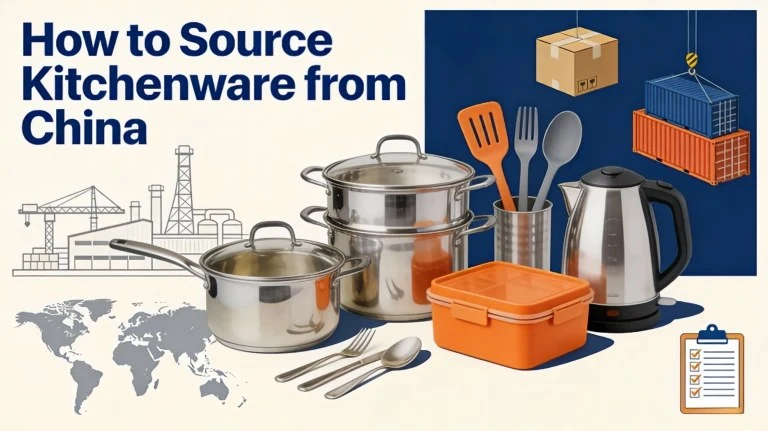
Sourcing kitchenware from China is one of the most profitable and scalable strategies for global importers, retail brands, and e-commerce sellers in 2026. China dominates the global kitchenware manufacturing market, accounting for over 35% of worldwide kitchenware exports, thanks to its mature industrial clusters, affordable raw materials, skilled labor, and flexible production capabilities. Whether you are a small startup looking for low MOQ kitchenware orders or an established brand aiming to optimize bulk pricing and supply chain stability, Chinese manufacturers can meet diverse business needs.
However, many new importers struggle with common pain points: unreliable suppliers, overly high minimum order quantities (MOQs), inconsistent product quality, opaque pricing, and complicated import procedures. Without a systematic sourcing strategy, it is easy to encounter delayed shipments, defective goods, or profit losses. This complete guide walks you through every step of sourcing kitchenware from China, covering supplier selection, low MOQ negotiation, quality verification, pricing optimization, and logistics management, helping you build a stable, cost-effective, and low-risk kitchenware supply chain.
1. Understand China’s Kitchenware Industrial Clusters & Product Specialization
One of the core secrets of successful China kitchenware sourcing is leveraging regional industrial clusters. Chinese kitchenware manufacturers are highly concentrated in specific provinces and cities, with each cluster specializing in distinct product categories. This geographical specialization means manufacturers in these areas have complete supporting supply chains, higher production efficiency, and more competitive pricing than scattered factories worldwide. Targeting the right cluster according to your product needs can greatly reduce sourcing risks and costs.
Guangdong Province is the top export-oriented kitchenware hub in China, mainly covering high-end and mid-to-high-end products. Key cities include Foshan Shunde, Zhongshan, and Dongguan. Local factories excel at stainless steel cookware, multi-layer composite pans, smart kitchen gadgets, and high-quality kitchen sets. Most manufacturers here support OEM/ODM customization, comply with international safety standards, and have rich experience serving European, American, and Australian brands. Their products feature fine craftsmanship and stable quality, ideal for mid-to-high-end retail brands.
Zhejiang Province, represented by Yiwu, Ningbo, and Wenzhou, focuses on mid-range daily kitchen tools and small kitchenware items. This cluster specializes in silicone kitchen utensils, plastic storage containers, kitchen cutlery, cleaning tools, and small portable kitchen gadgets. A major advantage of Zhejiang manufacturers is flexible MOQ policies, making them perfect for small importers and startup brands with limited initial order volumes. Yiwu, in particular, is the global wholesale center for small commodities, offering ultra-diverse kitchenware styles and fast sample production.
Shandong and Jiangsu Provinces are famous for cast iron cookware, ceramic tableware, and large-volume commercial kitchenware. Factories here have large-scale production lines, with lower unit prices for bulk orders. They are the best choice for importers focusing on cast iron pans, ceramic bowls and plates, and commercial kitchen equipment for restaurants and hotels. While their standard MOQs are relatively higher, long-term cooperative importers can negotiate flexible order terms.
2. Find Reliable Kitchenware Suppliers
Supplier reliability determines the long-term stability of your kitchenware business,if you find the supplier who can support you from development to mass production,you have been on the way to success in your business.
2.1 Search Factories In Google (Best for Big Order)
Normally if your company is big and your order is big,the buyers` KPI are strictly to count with a peny,then you have to search factories or manufacturers in China and list them out,send emails to them one by one and negotiation.Yes,it need to spend you a lot of times,if you just work for one part of it,do it;but if you need to take full procession from searching to importing,maybe find a sourcing agent is best for you.
2.2 Sourcing Agents (Best for Time-Saving & Risk Reduction)
For importers with no China local team or limited sourcing experience, professional China sourcing agents are ideal partners. Reliable local agents have in-depth understanding of the kitchenware industry, just like venus sourcing whom can screen qualified factories according to your needs, verify factory qualifications on-site, negotiate low MOQ and better pricing, and track production and quality inspection throughout the process. They can also help solve language barriers and cultural communication problems, greatly reducing your time cost and sourcing risks.
3. Master Low MOQ Sourcing Strategies for Kitchenware
High MOQs are the biggest barrier for small and medium-sized importers sourcing kitchenware from China. Many traditional factories set high minimum order quantities to ensure production profits, but with reasonable negotiation and flexible ordering strategies, importers can easily achieve low-MOQ sourcing for most kitchenware products.
First, distinguish between standard products and customized products. Stock standard kitchenware (common styles without logo printing or customized packaging) usually has the lowest MOQ, with most factories supporting 200–500 units per item. If you only need simple logo customization, many manufacturers can appropriately reduce MOQ requirements for new clients to accumulate long-term cooperative resources. For highly customized products with unique shapes, colors, or functional modifications, MOQs will be higher, so new importers are advised to start with standard stock products for trial orders.
Second, mix bulk orders to lower comprehensive MOQ. Most kitchenware factories allow mixed orders of different products in one container. You can combine small gadgets, cookware, and tableware in a single order to meet the factory’s total order volume requirement, while diversifying your product categories and reducing inventory pressure of a single item.
Finally, build long-term cooperative relationships. After completing 1–2 successful trial orders, you can negotiate permanent low MOQ terms with suppliers. Factories are more willing to provide flexible order policies and priority production rights for stable long-term clients.

4. Optimize Pricing & Control Hidden Costs
One of the core advantages of sourcing kitchenware from China is competitive pricing, but many importers only focus on unit product prices and ignore hidden costs, resulting in reduced overall profit margins. To obtain better pricing, you need to master scientific cost negotiation and cost control methods.
First, understand the composition of kitchenware costs. Product prices are mainly determined by raw material costs, labor costs, production process complexity, packaging standards, and customization requirements. For example, food-grade 304 stainless steel cookware is more expensive than 201 stainless steel products, and LFGB-certified silicone utensils have higher costs than ordinary silicone products. When negotiating pricing, do not blindly pursue low prices — excessively cheap products usually mean substandard materials and hidden quality risks.
Second, negotiate tiered pricing for batch orders. Most Chinese factories have obvious price gradients: the larger the order volume, the lower the unit price. You can communicate with suppliers to set tiered pricing standards, and lock in preferential unit prices for subsequent bulk orders based on trial order results. This strategy is very suitable for products with stable market demand and repeat orders.
In addition, control hidden import costs reasonably. Common hidden costs include customized packaging fees, certification fees, shipping fees, tariff costs, and after-sales loss costs caused by defective products. It is necessary to confirm all charging items with suppliers in advance, sign detailed quotation contracts, and avoid temporary price increases. Meanwhile, prioritize suppliers with complete international certifications to avoid customs detention and fine losses due to unqualified certification documents.
5. Strict Quality Control & Certification Compliance
Kitchenware is food-contact daily necessities, so quality and safety compliance are the top priorities of sourcing. Different countries and regions have strict mandatory certification standards for imported kitchenware. Uncertified products will be detained by customs, resulting in huge economic losses and brand reputation damage. Therefore, quality inspection and certification verification must run through the entire sourcing process.
For the US market, kitchenware must pass FDA food contact safety certification; for EU and German markets, LFGB certification is the core mandatory standard; for European general sales, CE certification is required. When screening suppliers, do not only view electronic certificate pictures, but verify the authenticity of certification numbers through official channels to avoid fake certificates. For special products such as non-stick cookware and cast iron cookware, additional quality testing on coating safety and heavy metal precipitation is needed.
In terms of on-site quality inspection, you can adopt three-stage inspection standards. First, inspect raw materials before production to ensure that the materials meet food-grade safety standards. Second, conduct inline inspection during mass production to check product size, craftsmanship, appearance, and functional consistency, and eliminate defective products in time. Third, arrange pre-shipment full inspection or third-party professional inspection before delivery to ensure that the defective rate is controlled within the agreed range.
For daily small kitchenware, simple self-inspection methods are also effective: check silicone products for peculiar odor and deformation after water soaking, verify the tightness of cookware lids to avoid shaking and gaps, and test the durability of plastic products to ensure no water seepage. Strict quality control can effectively reduce after-sales returns and exchanges and improve brand customer reputation.
6. Complete Order Execution & Smooth Logistics Arrangement
A complete kitchenware sourcing cycle from supplier confirmation to warehouse delivery usually takes 10–16 weeks for the first order, including sample confirmation, mass production, quality inspection, and logistics delivery. Many new importers make the mistake of insufficient advance planning, resulting in missed seasonal sales peaks. It is necessary to formulate a detailed time schedule according to your sales plan and reserve sufficient buffer time for production delays and customs clearance.
Sample confirmation is a key pre-production step. Before mass production, ask suppliers to provide formal production samples, confirm all details including product size, material, color, logo, packaging, and certification marks, and sign sample confirmation documents. Mass production can only be started after both parties confirm the samples, which can avoid large-scale product inconsistency caused by communication errors.
In terms of logistics selection, small-batch low-MOQ orders are suitable for air freight or international express delivery, with fast timeliness and simple procedures. Bulk orders are more suitable for sea freight with lower unit logistics costs. It is recommended to cooperate with professional freight forwarders familiar with kitchenware import business, who can handle customs declaration, tax payment, and cargo insurance procedures to ensure smooth cargo delivery.
7. Long-Term Supplier Relationship Management for Sustainable Sourcing
Sourcing kitchenware from China is not a one-time transaction, but a long-term sustainable supply chain cooperation. Excellent supplier relationships can bring continuous preferential resources for your business, including priority production rights, more flexible MOQ, lower unit prices, and faster after-sales response.
After each order is completed, timely communicate with suppliers to summarize cooperation problems, such as delivery delays, minor quality defects, or packaging problems, and put forward improvement requirements. Stable communication helps suppliers optimize production processes for your subsequent orders. Meanwhile, maintain regular interaction with suppliers, share your market sales data and product feedback, and assist factories in optimizing product design to match market demand.
In addition, avoid relying on a single supplier. It is recommended to reserve 2–3 alternative stable suppliers for core products, which can effectively avoid supply chain interruptions caused by factory production delays, equipment failures, or policy changes, and ensure the stability of your inventory supply.

Conclusion
Sourcing kitchenware from China is still the most cost-effective and flexible choice for global importers and brands in 2026. With complete industrial clusters, diverse product categories, flexible low-MOQ policies, and continuous optimized production quality, Chinese kitchenware manufacturers can meet the needs of startups and large-scale brands alike.
The key to successful sourcing lies in accurate cluster positioning, strict supplier verification, scientific MOQ negotiation, standardized quality control, and long-term supply chain management. By following this complete guide, you can effectively avoid common sourcing pitfalls, obtain reliable low-priced kitchenware products, build a stable and profitable supply chain, and gain strong competitive advantages in the global kitchenware retail market.
If you are going to sourcing kitchenware in China,and some questions need to consult with,pls contact us and our team is glad to help you.
Looking for a reliable kitchenware sourcing partner?
 Contact us for a fast quotation and flexible solutions.
Welcome to Share this Article