
Solution 1: Work with Professional Sourcing Partners Instead of Single Factories
Most new importers default to contacting individual kitchenware manufacturers directly, which locks them into that factory’s rigid MOQ rules. A far more flexible alternative is partnering with experienced kitchenware sourcing teams that maintain cooperative relationships with dozens of verified factories across major industrial clusters in Guangdong and Zhejiang.
Sourcing partners do not rely on just one production facility. They consolidate small orders from dozens of global buyers and distribute production across matching specialized factories, splitting large bulk production runs into smaller individual client batches. For example, if a stainless steel pan factory requires a 1,000-unit minimum order, your sourcing agent can combine your 200-unit request with 800 units ordered by three other small importers to hit the factory’s total volume requirement. You only pay for your small portion of the finished goods, while the factory receives a full acceptable production run with zero operational loss.
Key benefits of this model
- Dramatically lowered per-item MOQ: Many single-factory MOQs of 1,000–2,000 units drop to 500 units when consolidated via sourcing partners.
- Greater product flexibility: Agents can source cookware, silicone utensils, water kettles and ceramic tableware from separate specialized factories under one unified order and shipment.
- Reduced negotiation stress: Local sourcing staff handle all MOQ talks, production follow-ups and quality inspections on your behalf, removing language and cultural barriers that often stall small-order negotiations.
For importers who lack local China support teams or limited experience negotiating factory terms, consolidated sourcing partnerships deliver the fastest path to low-MOQ kitchenware procurement without sacrificing quality control.
Solution 2: Mix Multiple Product Categories into One Combined Shipment
Nearly all kitchenware manufacturers enforce minimum order rules based on either single-SKU unit count or total order value. A widely overlooked workaround is mixing diverse product lines into a single container or shipment to meet the factory’s total volume threshold, without purchasing large quantities of any individual item.
Instead of ordering 1,000 stainless steel frying pans alone to hit the factory’s MOQ, split your total order across complementary kitchen products that share compatible production schedules and raw material supply chains. Ideal mixed combinations for kitchenware importers include:
- Stainless steel cookware (small sauce pans, stock pots)
- Electric or stovetop water kettles
- Silicone cooking utensils, spatulas and baking mats
- Metal cutlery sets and food storage containers
For context, suppose a factory requires a minimum total order value of $5,000 to waive strict single-item MOQs. Rather than committing $5,000 to one single type of pan, you can split your budget across five separate SKUs: 150 sauce pans, 100 kettles, 200 silicone utensil sets, 120 frying pans and 80 storage canisters. Every individual item quantity stays far below the standalone MOQ, yet the combined order value satisfies the factory’s financial requirements.
This mixed-order strategy delivers two critical business advantages beyond reduced per-item volume limits. First, you diversify your product inventory to appeal to wider customer groups, balancing slow-moving cookware with fast-selling small gadgets. Second, you cut down overall inventory risk by avoiding overstock of a single product that might underperform in your target market. Mixed container ordering remains the most cost-effective MOQ workaround for importers planning full kitchen product lines.
Solution 3: Start with Limited, Simple Customization to Avoid Inflated MOQs
Full OEM customization is one of the biggest drivers of drastically higher kitchenware MOQs. Factories ramp up minimum order sizes significantly when buyers request custom molds, unique coating formulas, exclusive packaging designs or Pantone-matched colored metal finishes. Each major custom modification creates new fixed setup costs that manufacturers can only recoup through large production batches.
If you want to brand your kitchenware without facing 2,000+ unit MOQs, scale back your customization requirements to minimal, low-cost adjustments that factories support on small runs. Begin with standard off-the-shelf product bodies and only add lightweight branding upgrades, then expand to full custom designs once your trial orders prove consistent sales demand.
Low-MOQ friendly customization options to start with
- Basic laser logo engraving: No custom printing screens required; most factories accept 100–300 unit minimums for simple brand etching on cookware sides or utensil handles.
- Generic neutral packaging with small custom sticker inserts: Skip fully custom color boxes (which carry high printing MOQs) and add branded paper inserts inside standard factory cartons.
- Standard existing product dimensions and material grades: Stick to in-stock 304 stainless steel cookware sizes or pre-made silicone utensil shapes instead of requesting new mold development.
Once you complete one or two successful small trial orders and demonstrate steady repeat purchase intent, you can gradually negotiate full custom packaging and exclusive product designs with far more relaxed MOQ terms. This phased customization approach lets you test brand market reception before sinking capital into large fully customized batches.
Solution 4: Select Product Lines With Naturally Low Baseline MOQs
Not all kitchenware categories carry identical minimum order requirements. Certain lightweight, simple-design items rely on generic molds, shared raw material batches and streamlined production workflows, so factories set inherently lower baseline MOQs without extra negotiation. When building your initial low-volume inventory, prioritize these product groups to avoid high-volume commitments entirely.
Kitchenware items with naturally flexible small-order limits
- Silicone kitchen utensils: Spatulas, baking brushes, food mats and trivets often carry standard MOQs of just 100–300 units per SKU, as silicone molding setup costs are minimal compared to metal cookware stamping.
- Basic standard cookware: Plain polished stainless steel pots and pans without multi-layer composite bases use existing universal molds, supporting smaller order runs than premium multi-ply cookware.
- Simple metal accessories: Cutlery sets, measuring cups, wire whisks and food tongs require minimal machine retooling, making them ideal for mixed low-MOQ container orders.
Conversely, complex heavy-duty items such as fully composite multi-layer frying pans, cast iron cookware and electric stainless steel kettles carry much higher baseline MOQs due to intricate multi-step production processes. Balance your product lineup by mixing high-complexity premium cookware with low-MOQ small accessories to keep your overall order volume manageable. This product selection strategy eliminates the need for aggressive MOQ negotiation from the start of your sourcing process.
Solution 5: Negotiate Smartly With Factory Sales Teams for Flexible Terms
Even without sourcing partners or mixed product orders, skilled direct negotiation can cut standard MOQs by 30% to 50% with most kitchenware manufacturers. Successful negotiation relies on framing your requests around the factory’s financial interests, rather than simply demanding smaller order sizes. Three negotiation tactics consistently deliver reduced minimum order limits for importers.
Request formal trial order agreements
Nearly all factories will relax MOQ rules for first-time buyers who sign a clear trial order contract promising larger repeat orders if sales data proves positive. Explain your market testing goals upfront: you plan to launch a small retail trial batch, measure customer demand, and place bulk recurring orders within 60–90 days if the product sells well. Factories view this as a low-risk investment to lock in a long-term bulk client and will frequently slash single-item MOQs to accommodate your initial market test batch.
Ask for shared mixed MOQ across all your SKUs
Many manufacturers separate per-item MOQ and total order MOQ policies. Clearly communicate that you are willing to meet their overall minimum order value across multiple mixed SKUs, even if individual product quantities remain low. Most sales representatives have authority to waive rigid per-SKU minimums as long as the full order meets the factory’s total revenue threshold.
Build long-term cooperative credibility
Consistent, on-time payments and transparent communication build trust with factory management over time. After fulfilling one or two smooth trial orders, revisit your MOQ terms to request permanent low-volume order allowances for future restocks. Factories prioritize stable repeat buyers over one-time large orders, and long-term partners almost always receive permanently flexible minimum order standards as part of exclusive cooperation terms.
As a minor negotiation concession, you can accept a modest small unit price premium (usually 5%–15% higher than bulk wholesale rates) in exchange for reduced MOQs. The slight per-unit cost increase is almost always offset by drastically lower inventory storage and capital risk from smaller batch sizes.
Best Option: Source Directly From Specialized Low MOQ Kitchenware Suppliers
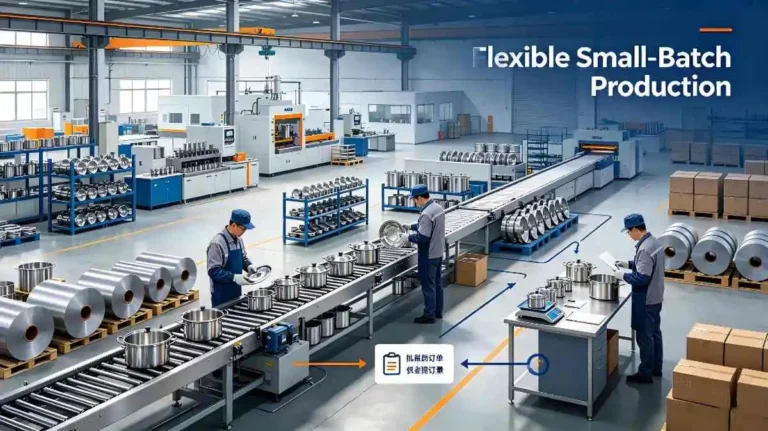
While the five strategies above work well for cutting MOQs with regular mass-production factories, the most straightforward long-term solution for small importers is partnering with manufacturers that specialize exclusively in low-volume, flexible kitchenware sourcing. These factories design their entire production workflows around small-batch clients, eliminating the need for constant negotiation or complex mixed-order planning.
Low MOQ kitchenware suppliers maintain semi-finished pre-manufactured inventory of standard cookware, utensils and kettles, which drastically cuts down machine setup and raw material waste costs. They accept small orders starting from 50–200 units per SKU, support mixed-SKU container consolidation, and offer streamlined light branding customization without inflated minimums. Their business model targets startup brands, e-commerce sellers and regional small retailers, so all their internal policies are built around flexible order sizes rather than large industrial bulk runs.
Working with dedicated low-MOQ manufacturers simplifies your entire supply chain workflow: you avoid consolidating multiple factories, skip lengthy MOQ negotiation rounds, and receive consistent small-batch production lead times without last-minute volume demands. If your business model relies on frequent small restocks and seasonal product testing, these specialized suppliers deliver the most stable, stress-free sourcing experience.
 Check options here: Low MOQ kitchenware supplier

Conclusion
High minimum order quantities do not have to limit your kitchenware import business growth. Every barrier that pushes factories to enforce large batch rules can be overcome with intentional, strategic sourcing planning.
To reliably reduce your kitchenware MOQ when importing from China, focus on five core actionable steps:
- Partner with consolidated sourcing teams to split factory bulk runs across multiple small buyers;
- Combine diverse cookware, kettle and utensil SKUs into one unified shipment to hit total order value requirements without overstocking single items;
- Hold off on full complex OEM customization during initial trial batches and stick to simple, low-setup branding;
- Prioritize naturally low-MOQ small kitchen accessories to balance high-volume premium cookware lines;
- Negotiate trial order agreements and build long-term supplier relationships to unlock permanent flexible order terms.
For the simplest, most consistent low-volume sourcing experience, turn to specialized low-MOQ kitchenware suppliers built to serve small importers and growing brands. By following these proven methods, you cut upfront inventory costs, lower capital risk, speed up market testing cycles and build a scalable kitchenware supply chain that grows alongside your business without forcing oversized, unmanageable bulk orders.
Want to start with low MOQ kitchenware orders?
Contact us today for flexible sourcing solutions.